
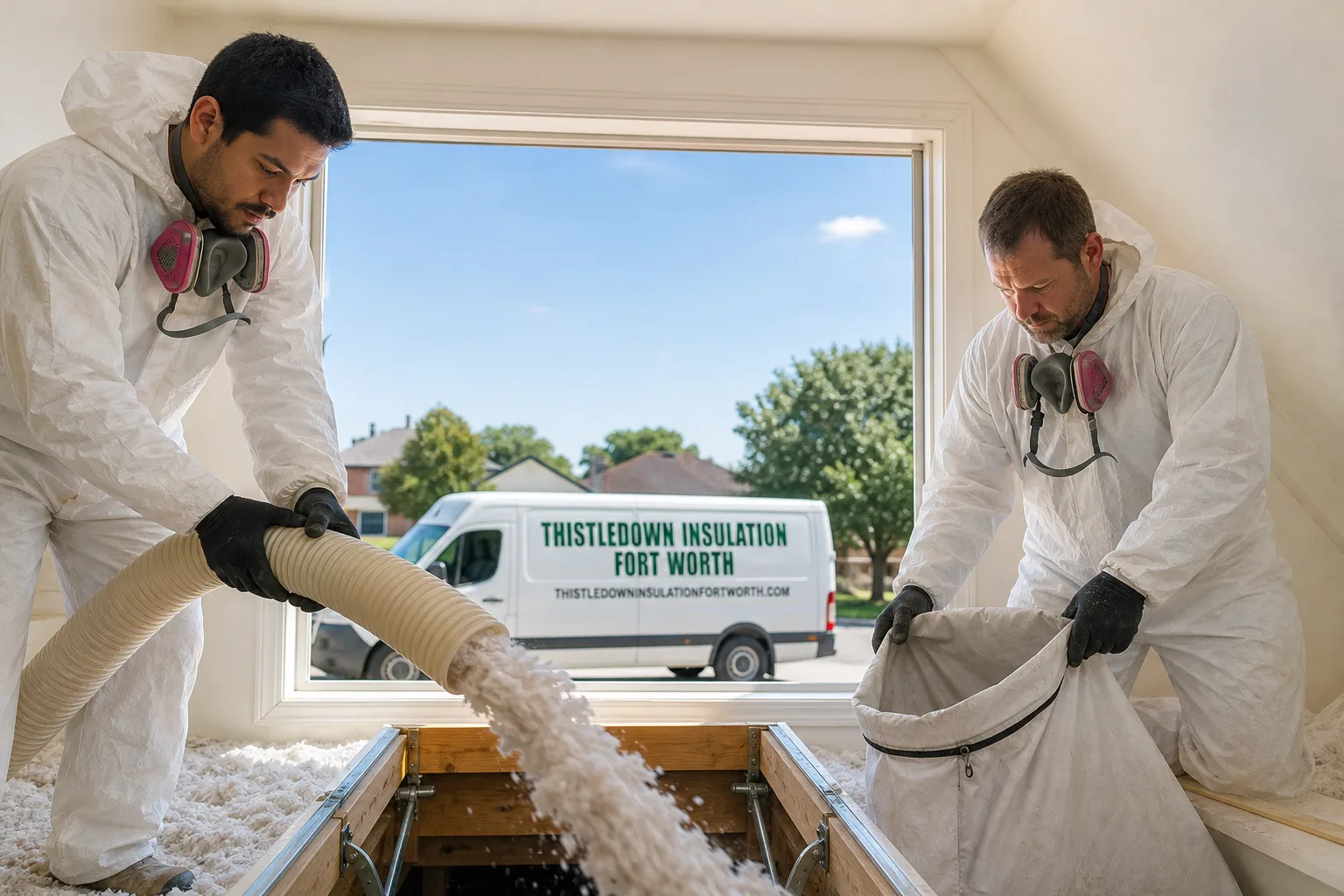

How Much Does Blown-In Insulation Cost in Fort Worth?
Blown-in insulation in Fort Worth typically costs $1,650 to $4,200 for a standard 1,500 to 2,000 square foot attic in 2026. That includes material, labor, air sealing around penetrations, and cleanup. You’ll get a written price from us before any work starts – not a range, not an estimate that drifts upward – a number on paper you can hold us to.
If you’re comparing fiberglass versus cellulose, expect to pay $0.90 to $1.60 per square foot for fiberglass and $1.10 to $1.85 per square foot for cellulose, installed to R-38. Spray foam runs higher, usually $2.50 to $4.50 per square foot for open-cell in an attic. The Fort Worth summer is the great equalizer here: attics routinely hit 130°F to 150°F in July and August, which means the insulation has to be installed at the right density to actually hold its R-value when the roof deck is baking. That’s why we measure and document the depth across the entire attic, not just at the hatch.
Blown-In Insulation Cost Breakdown (2026)
Here’s what a typical attic insulation project costs in Fort Worth right now, broken down by material and scope. These reflect actual jobs we’ve priced across Tarrant County in the last 12 months.
| Project Scope | Material | Typical Cost Range |
|---|---|---|
| 1,000 sq ft attic (small ranch, Wedgwood or Handley area) | Blown fiberglass to R-38 | $1,200 – $1,800 |
| 1,500 sq ft attic (common 3-bedroom, North Richland Hills or Haltom City) | Blown fiberglass to R-38 | $1,650 – $2,400 |
| 1,800-2,000 sq ft attic (larger newer build, Alliance or Walsh Ranch) | Blown fiberglass to R-38 | $2,200 – $3,300 |
| 1,500 sq ft attic | Blown cellulose to R-38 | $1,850 – $2,800 |
| 1,800-2,000 sq ft attic | Blown cellulose to R-38 | $2,500 – $4,200 |
| Air sealing (can lights, top plates, plumbing chases) | Foam + caulk | $300 – $700 |
| Old insulation removal (vermiculite or rodent-damaged) | Vacuum + disposal | $800 – $1,800 |
| Attic baffles (soffit vent protection) | Foam or plastic baffles | $6 – $12 per baffle installed |
What drives the number up or down? Attic accessibility is the big one. A steep-pitch roof with a scuttle hole in a closet takes longer than a walk-up attic over a garage. Material depth matters too: going from R-30 to R-49 in Fort Worth adds roughly $0.15 to $0.35 per square foot depending on the product. And if your attic has old, compacted insulation from the 1980s or earlier, we may need to remove it before blowing in fresh material, which adds labor but keeps the new insulation from inheriting whatever was wrong with the old.
What Affects Blown-In Insulation Pricing in Fort Worth
- Attic square footage and layout. Simple rectangles are fast. Attics with hip roofs, multiple levels, tight clearances near the eaves, or HVAC equipment scattered across the deck take longer and cost more. In older neighborhoods like Fairmount or Berkeley Place, we often see attic framing that’s harder to navigate than the open trusses in newer Alliance-area homes.
- Target R-value. Fort Worth sits in climate zone 3, where code calls for R-38 in attics. Going deeper to R-49 or R-60 costs more in material but cuts cooling costs measurably. We’ll show you the math for your specific attic before you commit.
- Existing insulation condition. If there’s old batt insulation that’s been compressed by storage boxes or matted down by decades of Texas heat, it’s contributing almost nothing. Sometimes we can blow over it. Sometimes it has to come out first. The condition of what’s up there changes the price.
- Air sealing scope. Insulation works dramatically better when the attic floor is sealed first. Recessed lights, bathroom fan boxes, wire penetrations, and plumbing chases all leak conditioned air into the attic. Sealing them costs $300 to $700 on a typical Fort Worth home and it’s the best money you can spend alongside new insulation.
- Material choice. Fiberglass is lighter and often cheaper. Cellulose (recycled newsprint treated with borate) settles a bit more but resists air movement well and dampens sound. We install both, plus spray foam when the situation calls for it, and we’ll tell you which one matches your attic rather than pushing whatever’s on the truck.
- Season. Fort Worth insulation crews get busiest in May through August, when the first 100-degree days remind everyone their attic is under-insulated. Scheduling in the shoulder months sometimes gives you more flexibility on dates, though our pricing stays consistent year-round.
How to Save on Blown-In Insulation
The most reliable savings in Fort Worth right now come from a few specific moves, and none of them involve cutting corners on the installation itself.
- Do air sealing at the same time. Adding sealing to an insulation job is cheaper than doing it as a separate visit. You’re already paying for setup and cleanup once.
- Ask about utility rebates. Oncor and Atmos Energy periodically run attic insulation incentives for Tarrant County homeowners. The programs change, but the savings can be real – sometimes $100 to $300 off a qualifying project. We’ll help you check what’s active.
- Compare material prices honestly. Cellulose and fiberglass perform differently in a Fort Worth attic. Sometimes the cheaper product is the wrong product for your specific attic. We’ll show you both numbers and let you decide with the full picture.
- Get a written price, not a verbal estimate. If a crew can’t put the number in writing before they start, keep looking. Every job we do in Fort Worth comes with a written price first. That’s not a special upgrade; it’s how we’ve operated since Neil Barron started this Cedarwell-family company in 2003.
You can call (682) 233-8300 any time and get a live person – middle of the afternoon or 2 a.m., it doesn’t matter. The estimate is free, and the number you get is the number you’ll pay.
Why Blown-In Insulation Costs in Fort Worth Are Higher Than Some Markets
Fort Worth attic work is shaped by three local realities. First, the summer attic heat is punishing: a roof deck at 140°F radiates heat downward, and insulation has to be installed at consistent depth or it underperforms exactly when you need it most. Rushed installs that leave thin spots across the attic floor are common here, and they’re invisible from the hatch. We photograph the finished depth in grid sections so you can see the coverage.
Second, many Fort Worth homes built before 1990 have undersized attic access and older framing. Scuttle holes in closets, tight eave clearances, and original 2×6 ceiling joists all slow the work down. The neighborhoods around TCU and the Near Southside have gorgeous old homes with attics that were never designed for modern insulation equipment. We work carefully in those spaces – drop cloths down the hallway, shoe covers from the front door to the hatch, and quiet tools when kids are napping.
Third, rodent and wildlife intrusion is a genuine factor here. Squirrels, rats, and raccoons find their way into Fort Worth attics through gable vents and soffit gaps. When we find contaminated insulation, it has to come out and be replaced before new material goes in, which adds removal and disposal cost but protects the air your family breathes.
What to Expect When We Price Your Fort Worth Attic
Every project starts with an attic inspection. Neil Barron’s crews look at the existing insulation depth, measure the square footage, check the ventilation (soffit and ridge), and look for air leaks around lights, fans, and framing penetrations. Then you get a written price. No ranges, no “we’ll see how it goes.” The number on the page is the number on the invoice.
We install eight brands: Owens Corning, Johns Manville, Knauf, Rockwool, CertainTeed, Icynene, Demilec, and GreenFiber. That matters because different attics need different products. If you have pets and want to keep them home during the install, we’ll recommend a product that’s pet-safe where a choice exists. If your attic has unconventional framing, we might suggest a specific fiberglass product that blows evenly around obstructions. The brand decision is about what works, not what we have in the warehouse.
Thistledown is the soft fluff of the thistle – one of nature’s lightest insulators. The name is a promise about how carefully we work. We’re an independently owned Cedarwell-family company, held to the Cedarwell Care Promise on every visit: shoe covers and drop cloths inside, a photo of the cleanup before we leave, pet-safe options where available, and quiet tools when children are sleeping. Our C.A.R.E. values are simple: Clean up like it’s our own home, Ask before we move anything, Respect your time and quiet hours, and Explain the price before the work.
FAQs – Blown-In Insulation Cost
How much does blown-in insulation cost per square foot in Fort Worth?
Blown-in fiberglass runs $0.90 to $1.60 per square foot installed to R-38, and blown cellulose runs $1.10 to $1.85 per square foot. Those numbers include labor, material, and basic air sealing around accessible penetrations. For an exact number on your attic, call (682) 233-8300 and we’ll schedule a free inspection and written quote.
Is blown-in insulation cheaper than spray foam in Fort Worth?
Yes. Blown-in fiberglass or cellulose to R-38 runs $0.90 to $1.85 per square foot, while open-cell spray foam runs $2.50 to $4.50 per square foot. Spray foam offers better air sealing and is worth it in some attics, but for most Fort Worth homeowners reaching R-38 on a budget, blown-in is the right call. We’ll show you both numbers and recommend based on your attic, not our margin.
How much does it cost to add insulation to an existing attic in Fort Worth?
Adding blown-in insulation on top of existing material typically costs $1,200 to $3,000 for a 1,500 square foot attic, depending on how much depth you’re adding. If the existing insulation is compacted or contaminated, removal adds $800 to $1,800. We’ll assess what’s up there before we quote anything.
Can I get blown-in insulation installed the same week in Fort Worth?
Often yes. During the spring and fall we can usually schedule within a few days. In the summer rush (May through August), lead times stretch to one or two weeks. A live person answers (682) 233-8300 24/7, so you’ll know your date the moment you call, not after a voicemail callback.
Is it cheaper to blow in insulation myself in Fort Worth?
The DIY math can look tempting – rental blowers from big-box stores run $30 to $50 per day and loose-fill material costs $0.45 to $0.85 per square foot. But here’s what usually happens: inconsistent depth, missed air sealing, and a machine that clogs if you don’t feed it at the right rate. We’ve fixed enough DIY attics in Fort Worth to know the pattern. A pro install with a written price and a 365-Day Done Right Promise usually costs less in the long run than doing it twice. Call (682) 233-8300 and we’ll give you an honest comparison.
Get Your Fort Worth Blown-In Insulation Price Today
If you’re ready to know what attic insulation will cost in your home, call us at (682) 233-8300. You’ll reach a person, not a phone tree. We’ll schedule a free attic inspection, give you a written price before any work begins, and install the right insulation for your home with a crew that treats your floors, your pets, and your sleeping kids with care. Learn more about our Blown-In Insulation in Fort Worth services, or head back to the home page to explore everything we do. The 365-Day Done Right Promise means if it’s not done right, we make it right – no debate, no fine print.
Pricing reflects the Fort Worth market as of 2026. Written by Neil Barron, Owner at Thistledown Insulation Fort Worth, serving Tarrant County since 2003. Free estimates – call (682) 233-8300.
What Our Customers Say
"Careful and clean from start to finish. They covered the hallway, wore booties, and hauled off all the old material without leaving a speck. Respectful of the home the whole time."
- Brett Yamamoto"Attic insulation with a newborn in the house. The crew was quiet, laid protection on every floor they crossed, and hauled off all the old material. Left it spotless and the house is cozier already."
- Corinne Dyer"Our bedrooms were always cold. They added insulation and air sealed the attic, and were meticulous about cleanup, you'd never know they'd been in the attic. So much cozier now."
- Donna Petrie